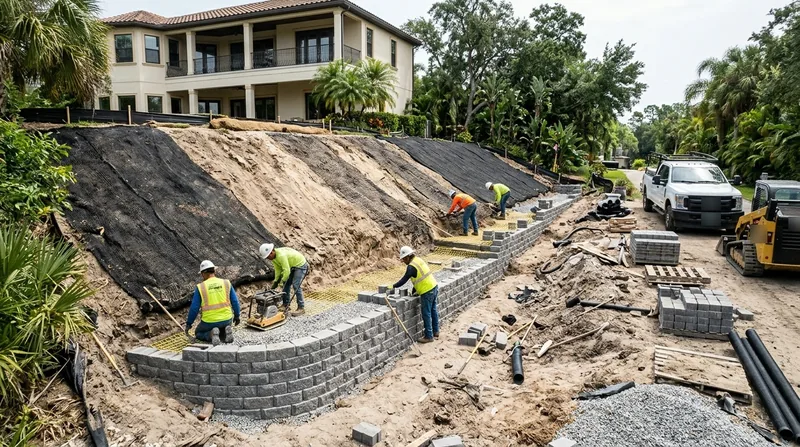




Slope Stabilization & Erosion Control in Tampa: Holding the Ground Under Your Home
Tampa sits on sandy soil over porous limestone, and the water table near the bay and the Hillsborough River runs high. When summer storms dump two inches in an hour, that sand moves. Slope Stabilization & Erosion Control in Tampa is the work of keeping banks, raised lots, and river bluffs from sliding out from under driveways, pool decks, and foundations. We build terraced retaining walls, set geogrid reinforcement, and install erosion control that protects the ground you own. If you have a bank washing out behind the house or a pond edge eating into the yard, call us at (656) 254-3746. For the structural wall work that often comes with it, see our retaining wall installation page.
Why Tampa Ground Fails: Sandy Soil, High Water, and Summer Rain
Most of Tampa is flat, low ground, so the slopes that do exist are short and steep: river bluffs in Seminole Heights, raised pads in New Tampa and Westchase, pond banks behind 1990s subdivisions, and seawall-backed lots on Davis Islands and the Bayshore streets. These are exactly the places where saturated sand gives way. The failure mode we see most is washout through open joints and undercut footings after hurricane-season rain.
- Saturated sand loses bearing capacity fast, and walls start to lean within one wet season.
- Water running through open joints scours the soil behind segmental block and stuccoed CMU walls.
- Karst settling opens voids under poured concrete at grade changes, and slabs crack.
- Old landscape timber borders rot at the soil line and stop holding anything.
- Pond banks in Westchase and New Tampa erode from the bottom up, not the top down.
Every one of these problems starts with water, which is why drainage and stabilization go together on every job we quote.
Key info: A Seminole Heights bungalow on a river bluff lost 18 inches of bank in one summer storm season. The fix was a terraced segmental wall with geogrid and a surface drain, not a bigger wall in the same spot.
For the official rules on grading and drainage work, check the City of Tampa Construction Services permit pages before you dig.
How We Stabilize a Tampa Slope: Step by Step
We start by reading the water, not the wall. On a Tampa job we walk the bank, check where runoff enters, and look for the limestone shelf under the sand. Then we build the fix from the bottom up, because a wall on soft ground fails no matter how good the block is.
- We survey the slope, the drainage path, and any structures within influence distance.
- We excavate to stable soil and bench the slope into terraces where the grade allows.
- We set geogrid layers and compact fill in lifts, tying the wall back into the bank.
- We install drainage: footing drains, weep points, and surface collection at the top of the slope.
- We place the wall face (segmental block, boulder, or poured concrete) and cap it.
- We seed, sod, or armorthe exposed ground above and below the wall to stop sheet erosion.
On a Riverview pond bank last spring, the homeowner had already lost six feet of yard. We rebuilt the bank with a boulder toe and geogrid-reinforced slope, then re-graded the top so stormwater ran to a swale instead of over the edge. See our boulder and natural stone walls page for that approach.
Key info: In Temple Terrace, a raised driveway pad was sliding toward the neighbor's lot. The repair was a low concrete wall at the toe plus a regraded swale, which cost far less than replacing the driveway slab.
Stabilization Methods We Use in Tampa
Not every bank needs the same fix. We match the method to the soil, the height, and what sits above the slope. Here is how the main approaches compare on Tampa ground.
| Approach | Description | Best for |
|---|---|---|
| Terraced segmental wall | Two or three stepped block walls with geogrid between lifts | River bluffs and tall banks where a single wall would be too high |
| Geogrid-reinforced slope | Layered mesh and compacted fill rebuild the bank behind a low face | Pond banks in Westchase and New Tampa losing ground at the toe |
| Boulder toe and riprap | Stone placed at the water line to break wave and flow energy | Pond and canal edges with steady water movement |
| Surface drainage and swales | Regrading and collection to move stormwater away from the bank | Raised lots and driveways where runoff causes the washout |
| Erosion blanket and vegetation | Armored matting and deep-rooted planting on exposed sand | Shallow slopes and newly graded ground before grass takes hold |
Most Tampa jobs combine two or more of these, because the water problem and the soil problem rarely stop at the same line.
Slope Stabilization & Erosion Control Cost in Tampa: What to Expect
We start every job with a free estimate, and that is the only honest way to price slope work. The number depends on how much bank is moving, how far down stable soil sits, and whether we can get equipment to the slope. A short pond bank with good access is a different job from a river bluff behind a Seminole Heights bungalow with a fence and a pool in the way.
Height and length of the fix drive the price first. Geogrid, drainage, and stone add material cost. Access is the wild card in Tampa: narrow side yards, seawall lots, and mature oaks on the bank can turn a simple wall into a hand-dug job. Getting two or three estimates is smart, and any contractor who quotes a bank without walking it is guessing. See our pricing overview for the full breakdown.
Slope Stabilization & Erosion Control Near Me: Hiring a Contractor Near Tampa
When you search for slope stabilization near me, you get a long list. Narrow it with the basics. Confirm the contractor is fully insured, and ask for the certificate, not just the claim. Get at least three written estimates that describe the fix, not just a price. Ask for local references on banks like yours, and call them.
Permits matter here. Many Tampa Bay jurisdictions require a permit for walls above roughly 4 feet from the footing, or when the wall supports a driveway or structure, and tall or tiered walls may need engineered drawings. Setback and property-line rules apply too, so verify the threshold with the local building department before work starts. If your lot is in an HOA, check the architectural rules before you pick a wall material. Ready to talk? Reach us through our contact page.
Don't Wait for the Bank to Fail
A leaning wall or a washing bank gets worse every storm season. We handle slope stabilization and erosion control across Tampa and the surrounding cities, and we give you a straight answer on what the ground needs. Call (656) 254-3746 for a free estimate. Fully insured.
Slope Stabilization & Erosion Control in Tampa: Pricing Guide
| Service | Price | Details |
|---|---|---|
| Free estimate and site walk | Free estimate | On-site slope and drainage assessment, written scope, no obligation to book |
| Erosion control and surface drainage | Starting at $1,800 | Regrading, swales, and erosion blanket for shallow banks with good equipment access |
| Geogrid-reinforced slope repair | Starting at $6,500 | Includes excavation, geogrid layers, compacted fill, and drainage, priced by bank length and height |
| Terraced or boulder stabilization wall | On estimate | Tiered walls and boulder toes need an on-site look for soil depth and access |
| Travel | Included | In Tampa and surrounding areas, no separate call-out or mileage fee |
| Estimate | Free | Response within 24h at (656) 254-3746, no obligation to book |
Indicative pricing, the exact cost depends on square footage, finish, and site access. Free personalized estimate within 24h at (656) 254-3746.


